Danil D. Kotelnikov

Danil D. Kotelnikov

Computational protein design, molecular docking, molecular diagnostics.

Research assistant at a biomedical research institute, designing single-domain antibodies against viral antigens. Reading for an MSc in Applied Mathematics and Informatics on the programme “Bioinformatics in Agriculture”. Fifteen papers across protein design, molecular modelling, plant genomics and molecular diagnostics.

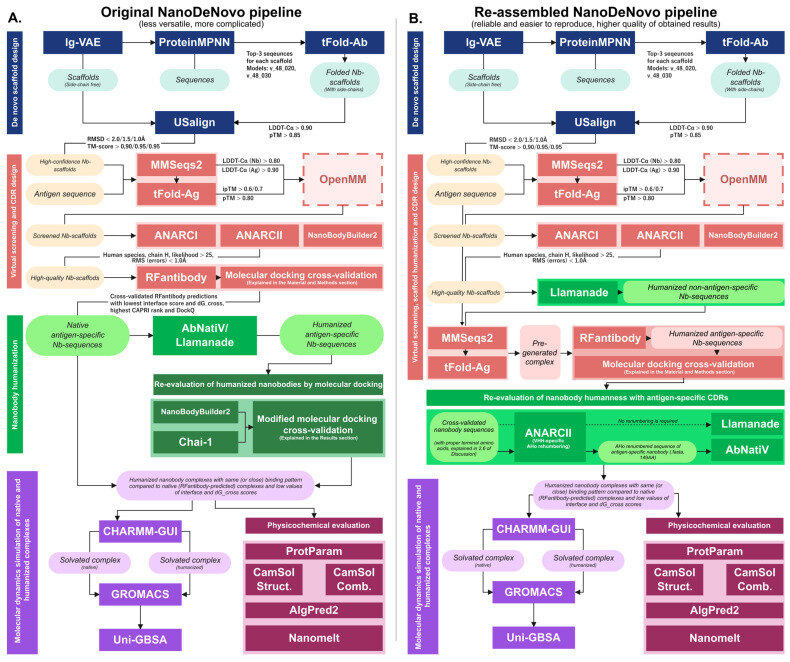
  • Schematic of the five-stage de novo nanobody design pipeline and its re-assembled redesign variant.

    NanoDeNovo: nanobodies designed from the antigen alone

    I built a five-stage pipeline that designs nanobodies against the poliovirus type 1 VP3 capsid protein. No immunisation, no display library. It samples scaffolds, predicts their structures, docks them to the antigen, redesigns the CDR loops on whatever survives, and humanises the final candidates. Rosetta relaxation runs last because it costs about a thousand times more per candidate than folding does. The five stages use different models and different failure criteria, so their errors have to be checked separately.

    Fig. 8. Kotelnikov, Tatarinova, Zhdanov, 2025. doi:10.3390/ijms26199262. CC BY 4.0.
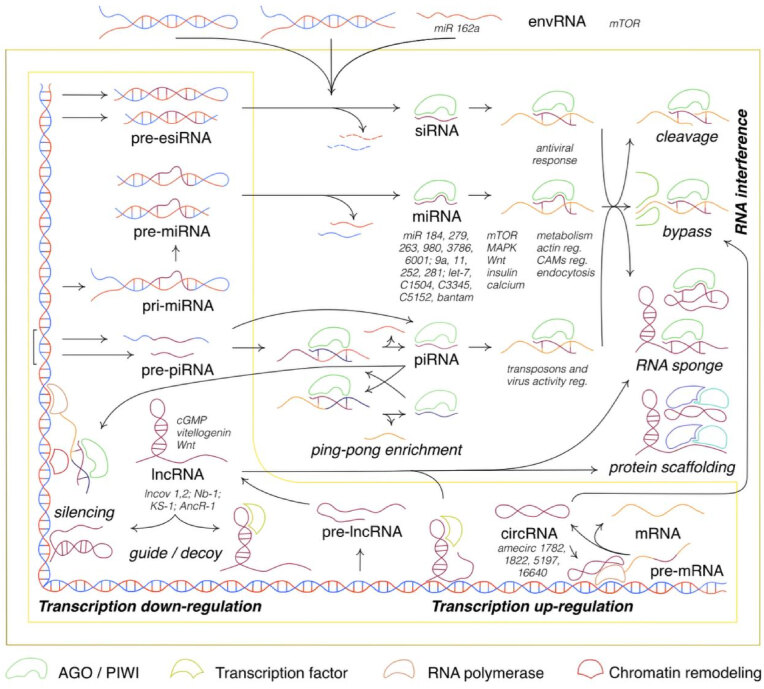
  • Map of regulatory non-coding RNA classes, their mechanisms of action and molecular targets linked to eusociality in Hymenoptera.

    Non-coding RNA and the eusocial transition

    I reviewed the evidence linking regulatory RNAs to caste development and social behaviour in bees, ants and wasps. The paper maps each RNA class to its mechanism and to the genes it regulates. It then asks how far expression profiles follow the shift from facultative to obligate sociality, and whether they help explain why that shift is hard to reverse.

    Fig. 1. Lebedev, Smutin, Timkin, Kotelnikov, Taldaev, Panushev, Adonin, 2025. doi:10.1016/j.ncrna.2024.10.007. CC BY 4.0.
  • Top mismatch cluster discrimination score by locus Cyathostomum nassatus COX1 17.86, Fusarium culmorum RPB2 8.44, F. culmorum TEF1 6.50, F. culmorum TUB2 5.00. C. nassatus COX1 17.86 F. culmorum RPB2 8.44 F. culmorum TEF1 6.50 F. culmorum TUB2 5.00

    Primery: primers placed on mismatch clusters

    Primery finds species-specific regions before any primer is designed. It BLASTs the target against its relatives, groups the discriminating positions into primer-length windows, and scores each window by how many species it separates and how consistently. Primer3 then designs inside the best windows under the constraints of the chosen chemistry. Designed pairs go back to BLAST for amplicon classification. When a locus cannot separate species, the report says so and gives the genus-level result.

    Top cluster discrimination score per benchmark locus. Manuscript in preparation.
  • Metal complexes as biological agents: structure and binding

    Gold(III) complexes with doubly protonated phenanthrolines, and binuclear copper(II) furancarboxylates with 5-nitro-1,10-phenanthroline. X-ray diffraction gave the copper coordination environment as a square pyramid, coordination number five, held together by hydrogen bonds and stacking between the aromatic rings. I worked on the computational side, modelling how Cu²⁺ binds mycobacterial proteins. Histidine and glutamate sites dominated. Both copper complexes suppressed viability in an ovarian adenocarcinoma line.

    Neither article is openly licensed, so no figure is reproduced here.
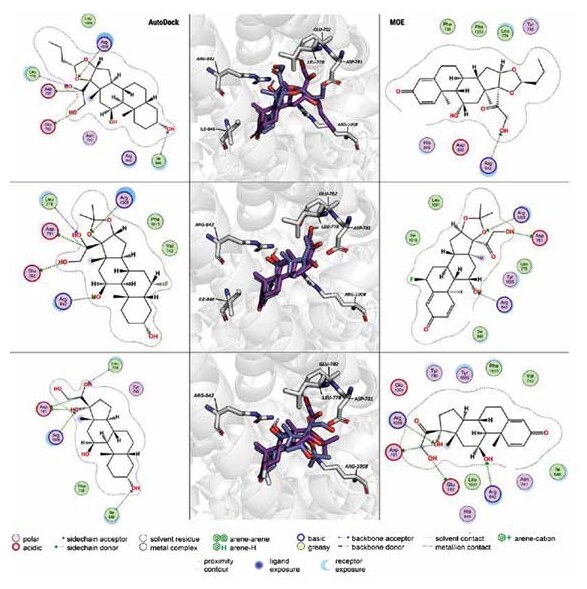
  • Two-dimensional ligand interaction diagrams and three-dimensional binding poses for glucocorticoids in the TRPM8 pocket, computed with AutoDock and with MOE.

    Cross-checked ligand docking on an ion channel

    We screened a panel of synthetic glucocorticoids against a predicted TRPM8 structure, taken from a structure database because no crystal structure was available. Each pose was computed twice, once in AutoDock and once in MOE. We then compared the two interaction maps residue by residue and accepted a result only where they agreed. One compound reached the residue set we cared about. The others formed stable complexes elsewhere on the channel.

    Ligand interaction diagrams. Timkin, Kotelnikov, Timofeev, Naumov, Borodin, 2024. doi:10.20538/1682-0363-2024-4-136-144. CC BY 4.0.
  • 2023 – Research assistant Laboratory of protein biochemistry and chemical pathology, biomedical research institute
  • 2025 – 2026 Bioinformatician Laboratory of molecular genetic studies of plants, agricultural university
  • 2024 – 2026 Researcher Laboratory of biotechnology, crop research institute
Structure prediction
AlphaFold2, AlphaFold-Multimer, AlphaFold3, tFold-Ab, Chai-1, Boltz-1, Protenix
Docking
AutoDock, AutoDock Vina, VinaGPU, MOE, Glide, Rosetta3, ClusPro, ReplicaDock, HDOCK, ZDOCK
Molecular dynamics
GROMACS with CHARMM36, AMBER14/19, OPLS-AA; CHARMM-GUI; CGenFF, OpenFF, GAFF, MCPB.py
Free energy
Uni-GBSA, gmx_MMPBSA; RMSD, RMSF, hydrogen bonds, PLIP
Assembly
ABySS2, SPAdes, MaSuRCA, MEGAHIT, RagTag, TGSGapCloser; KMC, Jellyfish, GenomeScope, smudgeplot
Language
Python with Biopython, NumPy, SciPy; PySide6 for interfaces; Linux throughout
Hardware
Intel Xeon Platinum 8368, 512 GB RAM

All notes

E-mail
danil.kotelnikov.02@gmail.com
Telegram
@yourlilygarden
ORCID
0009-0003-5159-5796
Availability
Open to relocation, EU and US